Saturn in Pisces, ‘full of mercy’, has closed the Blue Cafe. Rea stubbed out his last cigarette, stood up without hurry, and said quietly to himself, “That’s enough.” There was no drama. No tears in front of an audience. The only thing that lingered was something indefinable, emerging somehow out of nowhere.
When Henry Yates, the journalist who writes for magazines like NME, Metal Hammer, Louder, arrived at the house where Chris Rea lived, he says it took a couple of seconds to remind himself who he was standing in front of—an icon who sold millions, not just an ordinary gardener lost in his own world. Because Rea didn’t care that he was in camouflage pants, a stained Adidas vest, unshaven for a long-sought interview. Found in his sanctuary, his ‘man cave,’ surrounded by beloved guitars, as if he was waiting for him to arrive so he could light up. “There’s a certain discipline in being a rock star,” he told him in that warm, gravelly voice that consoled me one distant summer in the eighties: “…save your tears, got years and years…”. I picture him taking a slow, deliberate drag on his cigarette—just long enough for Yates to nod in quiet agreement—before landing the punchline:
“And I don’t have it. If I was a rock star, I wouldn’t have let a photographer in here, dressed like this. I’d have been down the hairdressers. You try and get Sting to do something without 15 advisors. These boys are like Russian princes…”
Direct. Brave. Himself. Heavy. Grumpy about anything fake or forced. Never satisfied. A true Mars. While recording one of his albums, the entire studio crew wore T-shirts printed with his smiling face and the caption: ‘This is what he looks like when he’s happy.’ A musician with the soul of a Formula One driver. The son of an ice cream seller who got kicked out of school because of gospel blues.
Husband. Father. Brother.
Chris Rea. A real man. That gentle blend of strength and vulnerability (Sun in Pisces) – direct yet withdrawn into himself, full of deep nostalgia for beaches (“On the Beach”), unforgettable loves (“Auberge”), childhood and first sighs (“Stainsby Girls”). For all those shelters and secret places that look no less like our own where we were once happy. Places we reach for when the world we live in gets too heavy, just like in “Tell Me There’s A Heaven.”
He once shared the story behind how that song was born. After news from the world showing footage of a man being burned, his daughter was visibly upset, and her grandfather, trying to calm her, said, “Don’t worry, he’s in heaven now and happy.” Later that same evening, Rea quietly told her:
“Grandpa told you there’s a heaven… and I’d love for someone to tell me there is one.”
Passion carefully woven into the softest verses. Accompanied by riffs that caress old soul scars without you even flinching that someone dared to touch something so personal, so deeply hidden. To make you cry, cheer you up, break you, and in the end leave you stronger. Never weaker. That’s not just talent. That’s the essence of a true man—the archetypal force in a woman’s psyche that never conquers through force, never suppresses or diminishes her strength, but instead quietly complements it, completes it, leaving her feeling truly whole. Complete. He wasn’t one of those for whom women are fatal illusions meant to awaken strong desire or obsession in a man. His women weren’t idealized goddesses or she-devils, but girls from the neighborhood, mothers, sisters, daughters, lifelong companions. They breathe, work, take kids to school while worrying about the world around. They’re stuck in traffic jam with their husband, nostalgic, craving a warm male embrace, and completely, utterly REAL. They’re not a projection or a dream. They love in silence, suffer hidden from others, wait for someone to write them a song, hug those they worry about. They can be quirky, pensive, tearful, smiling. But because Chris Rea saw them exactly as they are, every woman who listens to him feels truly seen – not as some fantasy, but as a real human being. With all her strength and all her vulnerability.
And that’s why today a woman driving home from work with her husband, just like Rea once found himself in a traffic jam with his wife and wrote “Driving Home for Christmas” in that chaos, read the news of Chris Rea’s death and just whispered, “Oh, no…” That’s why today a girl with a boring suburban job dreaming of a bright future paused when, after the TV news, they played “Bows and Bangles” and she recognized herself in it. And every Josephine named like Chris Rea’s daughter today played her song and shed a tear.
And that’s why I almost dropped my phone.
Because with him, that part of the archetype we never met as a destroyer, seducer, or conqueror. Only ever as a companion who helps us awaken ourselves, unobtrusively guiding us to break every cramp, uncover frozen fear, surrender to the tide.
And why did men pause for a moment too?
Precisely because of that.
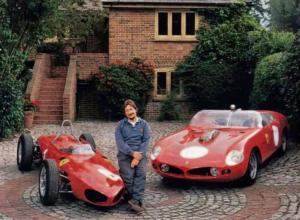
To call them with his guitar into his messy ‘man cave,’ full of boyhood dreams about Formula One. From tin car models, racing gloves, a gold CD underneath, across from a saw, picks, discs, to a half-used bottle of aftershave.
To empower them like an older brother or best friend – to finally let go.
To feel.
To show.
To stop running from themselves.
And just watch out you don’t knock over that Fender used on the album “The Road to Hell.”
Because it’s easier for them to admit everything to Chris Rea than to any woman.
Because in his voice they hear the echo of their own truths, without fear of judgment.
Because his songs smell of gasoline, rain, and cigarette.
Because with him they can cry in the car at three in the morning.
Because he is their safe place, just like ours.
That’s why it’s sad he’s gone.
He never imposed himself. He used to say about himself that he was ‘eternally lagging behind,’ buying his first guitar at 22 (“when I see Clapton, I think – what am I even trying…”). Because of Clapton he turned down MTV Unplugged, since if he’s struggling with a slow version of Layla, who knows how I’d sound… Later he regretted it, at least when he saw some really expensive car he liked.
And the only musician who raced at Monza.
Thank you for every road.
*
You must live, what you really love
You must be, only what you’re dreaming of
Like a bird rising in the sky
You are only, only to fly, only to fly
When you hear the sound you love
Do you turn and walk away
Is it something you are frightened of
Are you scared what it may say
You must not run, you cannot hide
It’s only what you really feel
It calls to you from deep inside
You’ve got to know this dream is real
Only to fly, only to fly, only to fly
*